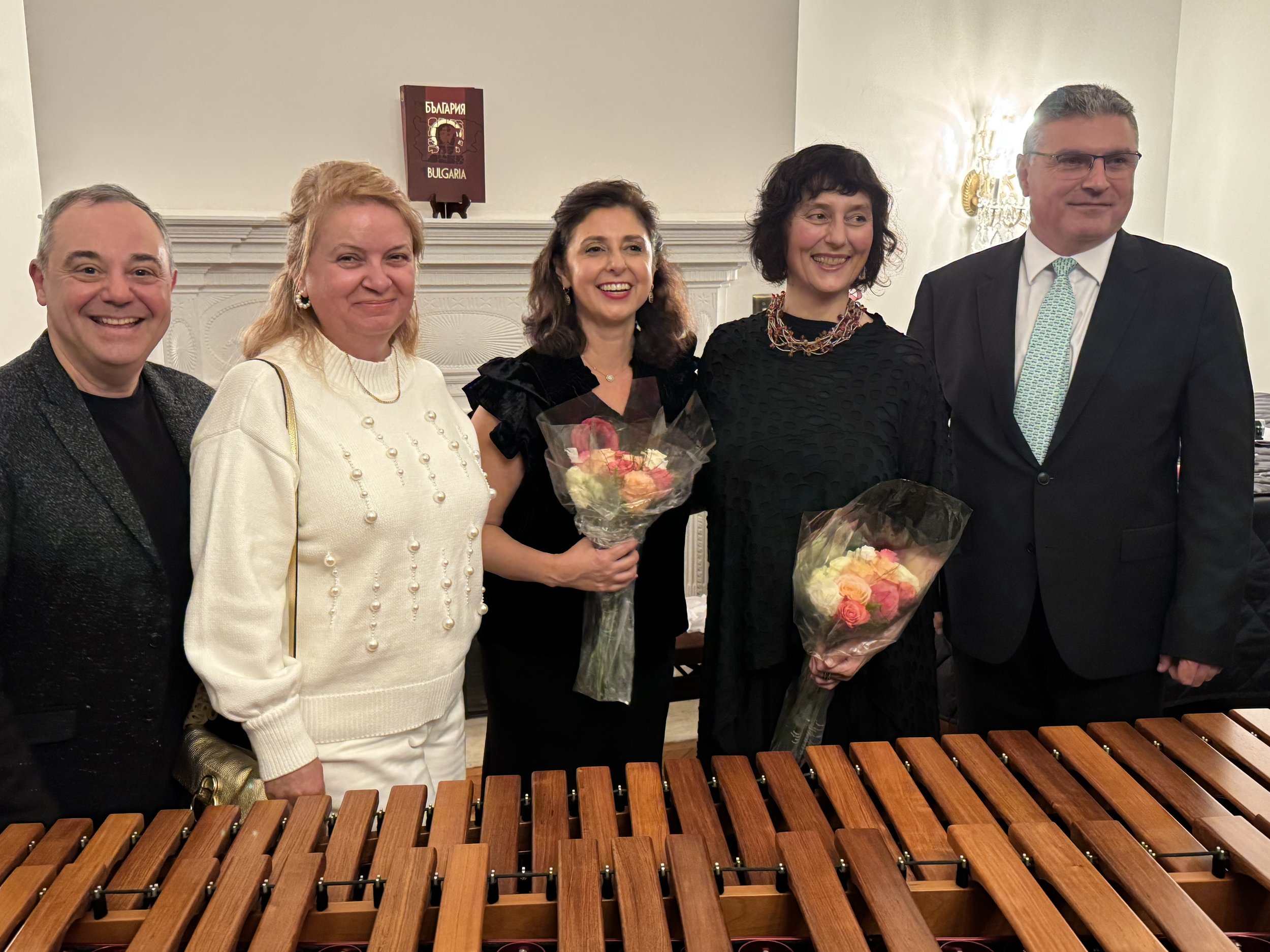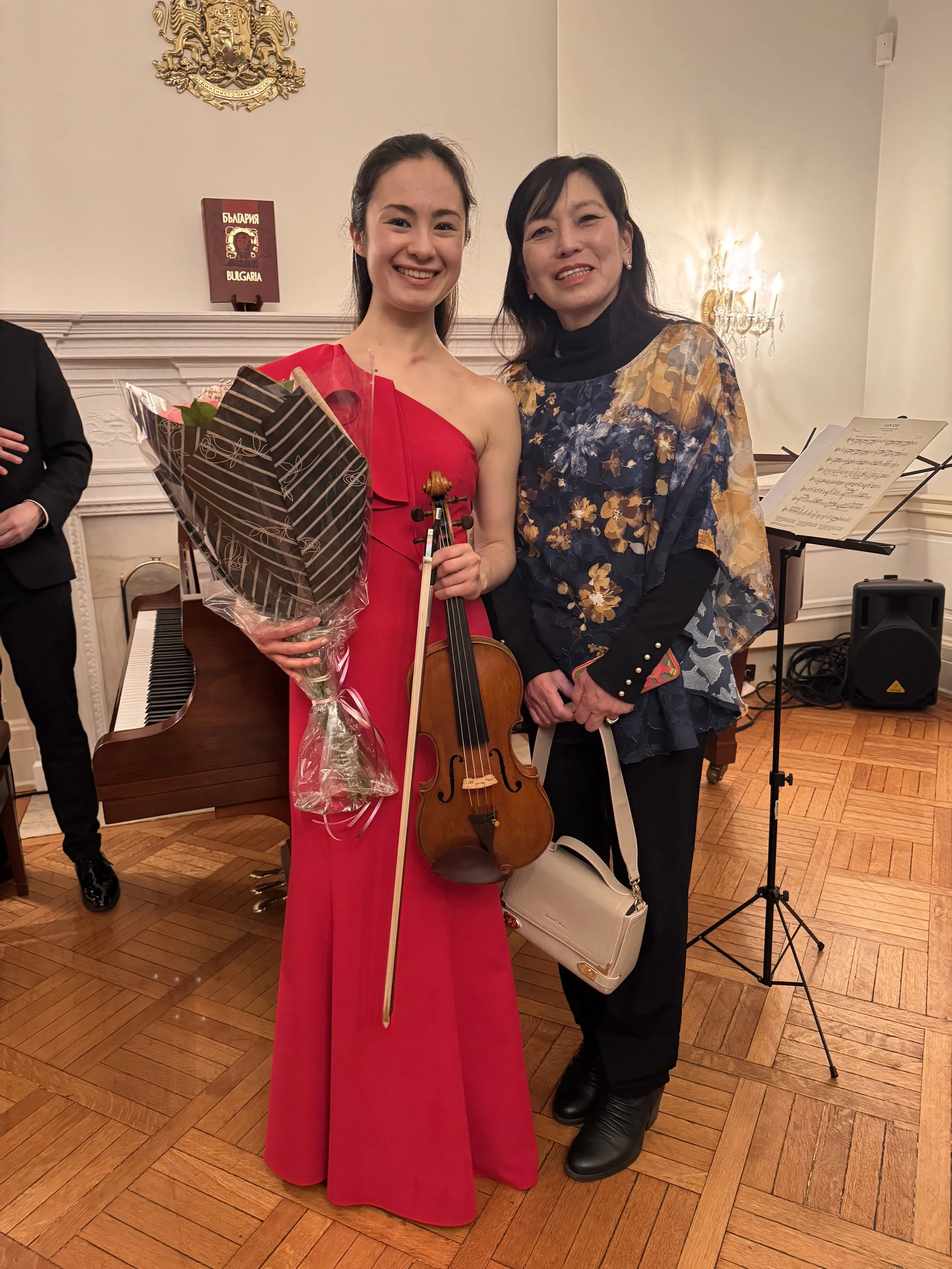
Between Pirin and the Northern Lights: Julia Angelov’s Recital in Washington
Julia Angelov stood upright with her delicate silhouette, absorbed in herself, her head slightly bowed — as if listening to her own soul, capturing the sounds of Bulgarian folklore and masterfully guiding her bow to recreate the characteristic techniques of a traditional Bulgarian ‘gadulka’.
At the invitation of the Bulgarian Musical Society in Washington, on March 6, 2026, violinist Julia Angelov gave a captivating recital together with the acclaimed pianist Christopher Schmitt at the Embassy of the Republic of Bulgaria.
The program, thoughtfully curated, opened with Violin Sonata No. 18 in G minor, K. 301 by W. A. Mozart (1756–1791). Known as one of the Palatine Sonatas and composed unusually in only two movements — Allegro con spirito and Allegro — the work sounded charming and deeply expressive, led by the violin. Each musical phrase was shaped and supported by the pianist’s virtuoso touch.
Praised by Washington Classical Review for her “melodic” and “elevated” tone, the young violinist also shared the inspiration and her personal interpretation of the suite “Pirin” by the Bulgarian composer Dobrinka Tabakova. For her, the emotional core of the piece is entirely authentic — drawn from a small church in the Rhodope Mountains and from the dramatic landscape of the Pirin range. Julia Angelov stood upright with her delicate silhouette, absorbed in herself, her head slightly bowed — as if listening to her own soul, capturing the sounds of Bulgarian folklore and masterfully guiding her bow to recreate the characteristic techniques of the traditional Bulgarian gadulka.
Who is Julia Angelov? A Bulgarian-Japanese violinist, born exactly twenty-five years ago in Washington whose spiritual aura seems equally connected to the towering Bulgarian mountains and the restless winds of the Japanese ocean. She astonished us with a deeply compelling performance — in sound, technique, and artistic maturity — combined with the pride of belonging to two ancient cultures, refracted through her own personality and the world in which she lives.
The climax of the evening came with the dramatic three-movement masterpiece by Edvard Grieg (1843–1907) — Violin Sonata No. 3 in C minor, Op. 45, known as his final chamber composition. It begins with a passionate opening, continues with a lyrical and romantic middle movement, and concludes with a highly energetic and vibrant finale. Not only for the magnificent duo of Julia Angelov and Christopher Schmitt, but also for the audience, it became a profound experience — touching the deepest strings of our emotions with its intensity and with the unmistakable influence of Norwegian folk music.
Christopher Schmitt, described by music critics as an “impressive talent” and “mature beyond his years,” and Julia Angelov, whose playing The Washington Post has defined as “carefully colored” and “sensitive,” demonstrated remarkable mastery in blending their individual musical styles. Without rushing or sounding chaotic, they performed in absolute harmony, painting a poetic musical landscape of Norway — illuminated by the Northern Lights and its snowy brilliance — colored melodically by the singing voice of the violin.
I will never forget this evening. The two performers were superb in their musical impressionism and interpretation. The applause was justifiably enthusiastic, celebrating their exceptional artistry and uncompromising professionalism. Naturally, the audience was rewarded with an encore: ‘Meditation’ from the opera Thaïs by Jules Massenet, providing a charming and graceful conclusion to an outstanding concert.
After the official photographs by the grand piano with guests and close friends, Julia Angelov reappeared among the audience with her violin on her back. Once again, I saw a young woman with a gentle, modest, and natural presence — someone for whom it is difficult to believe she is the recipient of the Milka Violin Prize at the Pablo Casals Festival in Prades, the Verao Classico Award, and a participant in masterclasses at Kronberg Academy, IMS Prussia Cove, Carl Flesch Akademie Baden-Baden, and the Heifetz International Music Institute.
She is currently supported by the DC Commission on the Arts and Humanities and the Markow Toteyv Foundation. She has presented a debut recital at Weill Recital Hall at Carnegie Hall, organized by Bulgarian Concert Evenings in New York. She has performed with the National Philharmonic at Strathmore, with the United States Army Orchestra, and has appeared on stages such as the John F. Kennedy Center, Merkin Concert Hall, Beethoven Hall at the Bolshoi Theatre, and the Prokofiev Hall of the Mariinsky Theatre.
Angelov currently studies with the renowned violinist Julia Fischer in Munich, Germany. Previously she studied with Aaron Rosand, Robert Lipsett at the Colburn School, and Olga Khroulevich. She performs on an Andrea Guarneri violin, generously provided by Jonathan Solars Fine Violins — an instrument she carries close to her heart, listening to the universe and seeking to understand, in her own words, “who we are and what we are.”
© Nelly Tsoneva, Krassi Genov
Washington DC, March 2026
The Young Stars of Classical Music
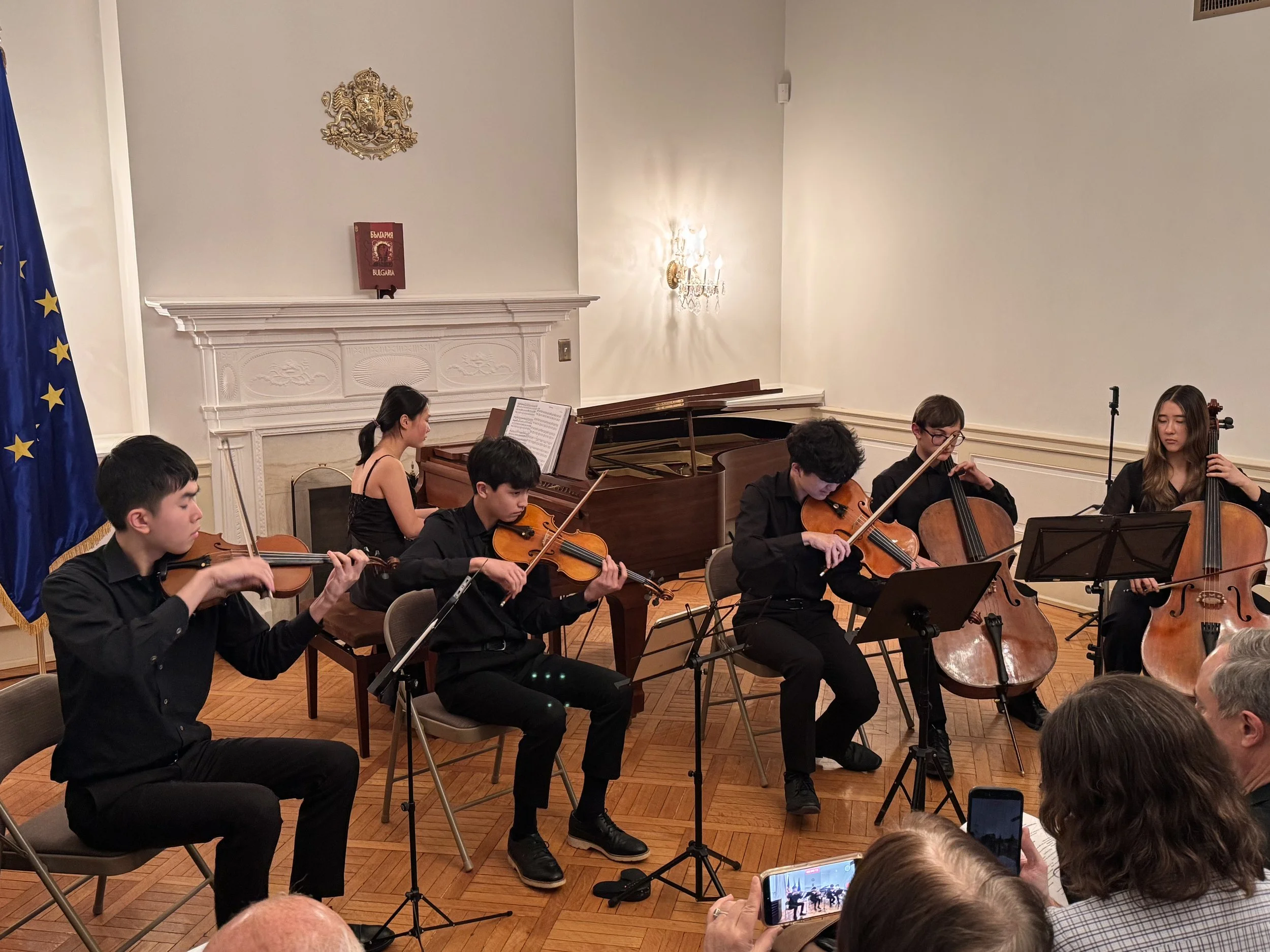
The Concert at the Bulgarian Embassy in Washington Revealed Unexpected Young Talents The evening of February 6, 2026 at the Embassy of the Republic of Bulgaria in Washington turned into the most moving musical celebration. The Bulgarian Musical Society, in partnership with the American Masters Music Awards (AMMA), presented a concert titled "The Young Musical Stars" - an event that confirmed that they are the future talents of classical music.
The Concert at the Bulgarian Embassy in Washington Revealed Unexpected Young Talents The evening of February 6, 2026 at the Embassy of the Republic of Bulgaria in Washington turned into the most moving musical celebration.
The Bulgarian Musical Society, in partnership with the American Masters Music Awards (AMMA), presented a concert titled "The Young Musical Stars" - an event that confirmed that they are the future talents of classical music.
The "Ghost" of Beethoven
The concert began with the performance of Piano Trio No. 5 in D major, Op. 70, No. 1 ("Ghost") by Ludwig van Beethoven (1770-1827). The performers - Connor Kim (piano), Alexander Moon (violin) and Hanna Bell (cello) - represent the ensemble "Topaz Ensemble", formed in 2022. The work is known as a "musical autograph", dedicated to Countess Marie von Erdödy, at whose estate Ludwig van Beethoven was a guest. The piano trio is somewhat strange, mystical music, inspired by Shakespeare's "Hamlet" from the ghost scene, as well as by "Macbeth" with the Witches' Chorus.
The ensemble unity brought special expressiveness to the sound picture, colored with "ominous" nuances and revelations in tones, reaching their culmination on the cello. It is no coincidence that "Topaz Ensemble" continuously wins distinctions, and in 2025 received the prestigious Best Performer award at the AMMA Metropolitan Music Festival.
The Magic of the Flute
Alicia Kim, a flutist and member of the American Youth Philharmonic, elevated to the highest level of the orchestra and additionally ranked first place in Korea. With elegant artistry and gentle sound, she presented "Fantaisie" by Georges Hüe (1858-1948). This is one of the most famous works in the flute repertoire, composed in 1913 for the exam at the Paris Conservatory and dedicated to the legendary professor Adolphe Hennebains.
The gentle breath of the flute, the virtuosically presented lyrical passages, were skillfully emphasized by the accompaniment of Maribeth Gwen on piano. As if the soul of the flute was tamed by Alicia Kim's fingers, demonstrating maturity far beyond her years. It is no surprise that she performs leading flute parts every year in the musicals at Georgetown Day School in Washington.
The Magnificent Mozart
Twelve-year-old pianist Caroline Li presented Sonata in B-flat major, KV 570 by Wolfgang Amadeus Mozart (1756-1791). This is one of Mozart's more mature creations, completed in February 1789, distinguished by refined elegance and special intimacy.
Caroline's performance was a true revelation. Placing her hands on the keyboard, she made it freely "speak" quite naturally with talent and intuition, penetrating the meaning of the piano melody. Not a single note was missed, every nuance was in its place. Solemn and brilliant, the youngest pianist had sensed Mozart's exceptional ethereal style and deservedly won the hearts of the audience.
The Lyricism of Schumann
Aaron Huang, an eleventh-grader from Richard Montgomery High School, who has played cello since the age of seven, performed the first movement of Cello Concerto in A minor, Op. 129 by Robert Schumann (1810-1856), with piano accompaniment by Jeongseon Choi. Schumann's Cello Concerto is one of the most poetic works in the repertoire, composed in 1850 in two weeks in a burst of inspiration.
Aaron captured the sad romance of the work, combining technical precision with deep emotional expressiveness. His tone was rich and singing, the phrasing - meaningful. In addition to his active musical activity as a chamber performer, Aaron finds time for ice hockey and reading manga - evidence of a balanced approach to life.
The Passion of Piazzolla
YMIC String Ensemble - Raymond Lim and Daniel Won (violins), Jonathan Y. Chi (viola), Hanna Philippy and Julie Amyot (cellos) and Minjae Leon (piano) - presented "Libertango" by Astor Piazzolla (1921-1992). This is an emblematic tango nuevo composition, created in 1974 as a symbol of liberation from traditional tango forms. The ensemble achieved an astonishing performance, perfectly capturing Piazzolla's characteristic combination of passion, nostalgia and modern energy.
The rhythmic precision was impeccable, the dynamic contrasts - dramatic, and the interaction between instruments - organic. Minjae Leon's piano accompaniment provided a solid foundation upon which the string instruments built an artistically accented sound picture with strong emotional impact.
The Range of the Young Stars
Worth noting is the performance by Felicia Hu - clarinet, with piano accompaniment by Johnson Choi of Concerto in F minor, I. Allegro by Carl Maria von Weber (1786-1826) with pastel and dreamy sound nuances, saturated with the exotic timbres of the clarinet; the performance of Violin Concerto in E minor, Op. 64, III movement by Felix Mendelssohn (1809-1847) by the duo Vivian Tang (violin), Young Ji Kim (piano); Suite "Dolly", Op. 56, No. 6 by Gabriel Fauré (1845-1924) by piano duo Noah Ku and Finley Chong. Each one of them was musically gifted and with an original presentation style.
The Romance of Franz Liszt
The culmination of the concert was two significant works by Franz Liszt (1811-1886): Transcendental Etude No. 10 ("Appassionata") performed by Charles Zhao and Hungarian Rhapsody No. 13 in A minor, performed by Arnav Iyengar. Both young pianists are from Washington, approximately the same age, love mathematics and excel in mathematical competitions. Arnav is also passionate about tennis, hiking and chess, while Charles is captivated by computer science, programming and robot construction. Both began piano training at 5-6 years old. Arnav has been studying for 12 years with Joseph Currie, and Charles currently studies with Margarita Gramatikova. What unites them in friendship is their passion for Franz Liszt - composer and great pianist of Romanticism. Their performances were simultaneously unforgettable and contrasting in approach and interpretation.
Arnav Iyengar - Hungarian Rhapsody No. 13 in A minor: Arnav's performance was distinguished by seeking the emotional foundation of the work. He emphasized the poetic intonation, his sound was artistically accented, the phrasing - expressive. His virtuosic style underscored the Hungarian folk character of the themes and their brilliant variations. One could feel how the young pianist immersed himself in the soul of the music, recreating it with inspiration.
Charles Zhao - Transcendental Etude No. 10 ("Appassionata"): Charles offered a more structured approach. He rose above the individual fragments, making the detail tangible through "hammered" pathetic sound. His technical precision was impressive, the dynamic contrasts - dramatic. The etude, known for its exceptional technical difficulty, was mastered with enviable confidence. Epilogue of the Triumph The concert ended with prolonged applause.
The audience long greeted the young talents with exclamations of "Bravo!" and "Success at Carnegie Hall!" In a spontaneous and happy moment, Arnav Iyengar and Charles Zhao sat together at the Steinway and, smiling, competed with Lisztian keyboard colors and nuances, interweaving their hands on the keyboard. The sound they created together was magical - proof that the young musicians not only master the technique, but also understand the essence of music-making: the joy of sharing.
Conclusion
The concert "The Young Musical Stars" confirmed that classical music continues to attract and form exceptional talents. Each of the performers demonstrated not only technical mastery, but also musical maturity, individuality and passion for art. The Bulgarian Musical Society and the American Masters Music Awards deserve congratulations for organizing this inspiring event, which not only presented the young talents on a worthy stage, but also emphasized the importance of musical education and cultural ties between Bulgaria and America. The future of classical music shines brightly in the talented hands of these young virtuosos.
© Nelly Tsoneva, Krassi Genov
Washington DC, February 2026
Music and More: Film Magic for Piano Duo Four-Hands
Ivo Kalchev, known as a brilliant piano artist with "impressive technique," an excellent educator and dedicated teacher of students, professor of piano, head of the Music Department and piano division at the Catholic University of America in Washington, D.C., in combination with Tanya Tachkova, who is highly acclaimed by critics for her solo performances and concerts in the United States and around the world
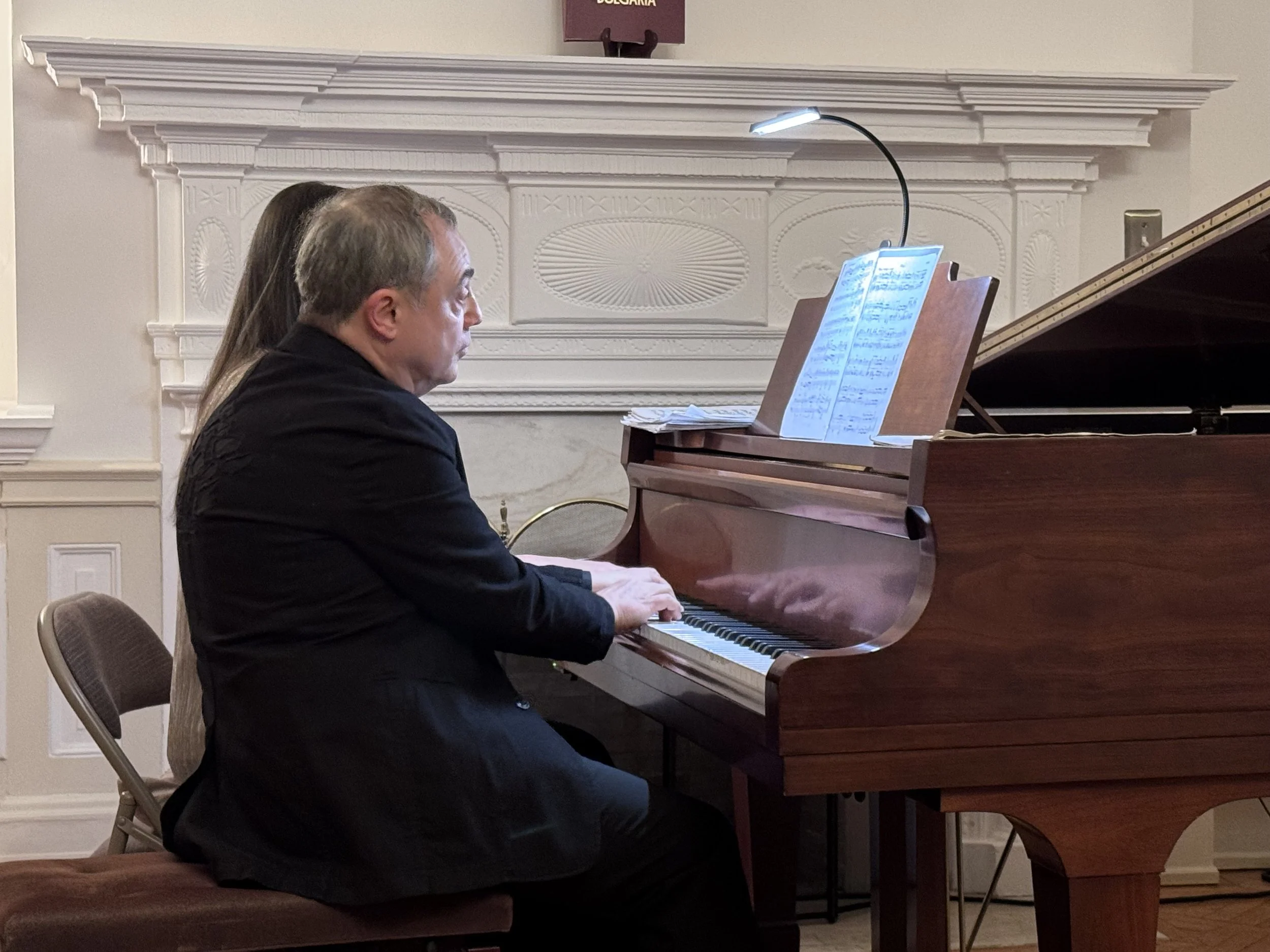
On Friday, January 23, 2026, the Bulgarian Musical Society in Washington presented an original and deeply moving event at the Embassy of the Republic of Bulgaria — "Music and More: Film Magic for Piano Duo Four-Hands" with Ivo Kalchev and Tanya Tachkova. For the audience, this performance was stunning! It is truly possible to play from memory and by feeling. But to see how four hands position themselves next to each other in absolute simultaneity, to achieve harmony in every decisive strike on the keys or that "sharpness" that emphasizes the culmination of the dramatic effect, is something incredible in its impact.
Ivo Kalchev, known as a brilliant piano artist with "impressive technique," an excellent educator and dedicated teacher of students, professor of piano, head of the Music Department and piano division at the Catholic University of America in Washington, D.C., in combination with Tanya Tachkova, who is highly acclaimed by critics for her solo performances and concerts in the United States and around the world with a doctorate in musical arts from Stony Brook University and a teacher in New York, the two build with trust and creative experience a new dramaturgical concept, moreover realized in an unusually short time — to dedicate themselves to the magic of film music.
Their repertoire included a rich palette of popular film titles such as "The Great Dictator" (1940) by Charlie Chaplin — a genius in the art of film, from which we heard "Hungarian Dance No. 2 in D minor" and "Hungarian Dance No. 5 in F-sharp minor" by Johannes Brahms (1833-1897). Music from the film "Schindler's List" (1993) by composer John Williams, who also wrote the music for "E.T. the Extra-Terrestrial" (1982). We heard the same theme in the film "True Lies" (1994) as well.
"Libertango" also resonated — the most famous work by Astor Piazzolla, which was used by director Roman Polanski in the film "Frantic" (1988), where Harrison Ford dances to Piazzolla's music, as well as in British director Sally Potter's film "The Tango Lesson" (1997).
The audience held its breath when the popular tango, created in 1935 by singer and composer Carlos Gardel, was performed in Martin Brest's film "Scent of a Woman" starring Al Pacino, which brought him the Oscar award.
We recalled "Titanic" — James Cameron's hit film, where the song "My Heart Will Go On" is the main soundtrack with Celtic motifs, emphasizing the tragic love story.
Or our familiar animated characters Tom and Jerry with the performance of "Hungarian Rhapsody No. 2" by Franz Liszt in "The Cat Concerto" (1947).
I really wanted to hear the first music entirely composed by a famous musician for the film "Pat Garrett and Billy the Kid" by singer Bob Dylan, but instead I learned something more from the film "The Legend of 1900," whose title in Italian literally sounds like "The Legend of the Pianist on the Ocean" (1998), whose music was composed by the great Ennio Morricone, who created legendary compositions for cinema and lived to the age of 91.
According to him, in every art, the heart is the best advisor and good taste will always be fashionable!
Thanks to the wonderful piano duo Ivo Kalchev and Tanya Tachkova, we were drawn into a musical fresco of melodies and stories, delighted by such a familiar cinematic experience. Images and characters from many beloved films came alive in us with an amazing thematic unity and a very original musical interpretation.
It was as if the entire concert was some kind of artistic game, consciously evoked by the piano duo, to make us feel satisfied with this most genuine and living music.
© Nelly Tsoneva, Krassi Genov
Washington DC, January 2026
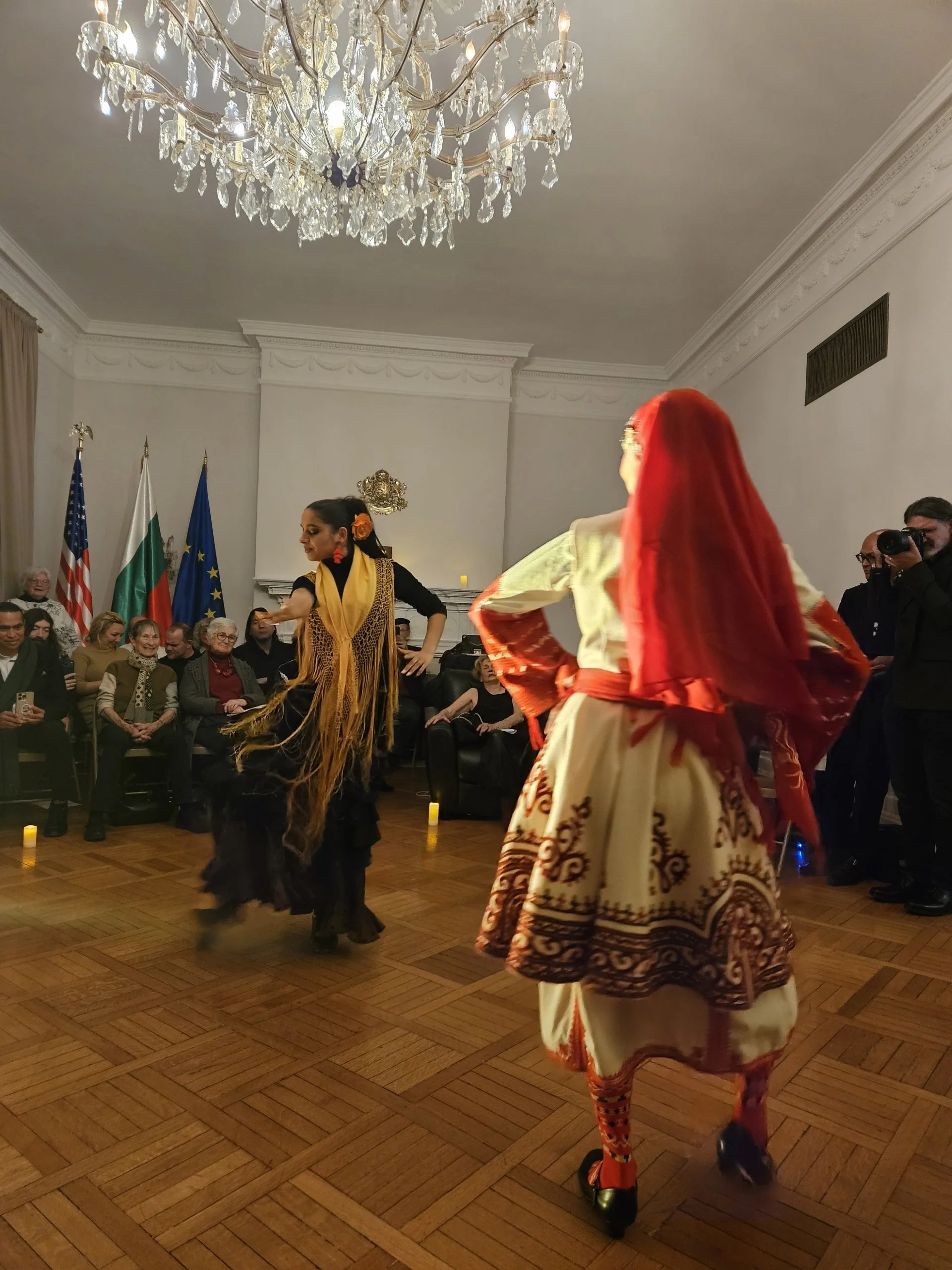
Dancing Across Borders: Bulgaria, Spain, America
On November 14th, the Bulgarian Embassy in Washington hosted the second concert of the Bulgarian Music Society's 17th consecutive concert season. The evening became a memorable cultural event that united two passionate dance traditions and captivated the audience.
Magic in an Intimate Space
The hall barely accommodated everyone wanting to attend this unique performance. Many guests stood around the improvised small square in the center of the salon, specially prepared for the dances. "This concert underscores our commitment to cultural dialogue and the unifying power of art," shared Ivo Kalchev, the society's artistic director.
Ancient Rhythms Come Alive
When the nestinari rhythms echoed in candlelight, Desi Yordanov appeared—a master of Bulgarian folk dances. Dressed in authentic costume, she swept into the whirlwind of ancient Bulgarian dance with such grace that the audience seemed to hold its breath.
Desi Yordanov is a professional performer, choreographer, and director of folklore ensembles and groups who has dedicated her career to preserving and promoting Bulgarian folk traditions. Her choreography of Bulgarian folk dances set to Beethoven's 9th Symphony was captured in the unique film "Dancing Joy," for which she received a gold medal at the Indice Dance Festival in 2019.
The program included Shopi dances, a Pirin bouquet, and Thracian teases—each evoking the aroma, expanse, and exotic beauty of Bulgaria. With elegant steps and precise technique, Yordanov took the audience on a journey through different regions of the country, revealing the richness of Bulgarian folklore.
Fiery Flamenco
Mariana Gato Duran's performance began stunningly and breathtakingly with her magnificent dress (bata de cola). She was like a flying bird, freezing in expressive and passionate interplay of body and hands, reminiscent of those gypsy melodies filled with feelings of love and sorrow. The atmosphere plunged into a mix of fire and pain.
Mariana, of Bulgarian origin, has been devoted to Spanish dance since she was six years old. She trained under the best masters of the Andalusian folk genre and has danced on stages in Barcelona and Madrid. In Washington, she has performed with the legendary group Gipsy Kings, as well as on their U.S. tour, establishing herself as one of the region's leading flamenco performers.
In her traditional magnificent costumes, Gato Duran danced with great enthusiasm befitting her artistic nature. Her performance demonstrated the perfect technique and emotional depth that characterize authentic flamenco.
Dialogue Between Cultures
The meeting of Bulgarian folklore with flamenco at first glance seemed improvised, but it revealed deep parallels between the two traditions. Both are rooted in ancient rhythms, both carry within them joy and melancholy, both speak the language of passion and authenticity. The beautiful guitar improvisations by Miguel Perez (Miguelito) complemented the evening's unique atmosphere, turning it into a friendly "competition" filled with passion and energy. His performances served as a bridge between the two traditions, emphasizing the universal language of music.
The Power of Art to Unite
The concert's motto, "Dancing Across Borders: Bulgaria, Spain, America," reminded all present of art's power to build bridges and unite cultures. We watched the magic of these whirling dancing performers, and everyone discovered for themselves what richness and talent are preserved in folk traditions.
As always, the Bulgarian Music Society proved its unique ability to create programs that are simultaneously diverse and deeply connected—like a conversation between past and present, between different cultures and traditions.
The evening was not simply a concert, but a celebration of culture—a synthesis of dance, music, and tradition. A memory that will remain long in the souls of those present who had the opportunity to experience the beauty of this cultural fusion.
© November 14, 2024, Washington by Neli Tsoneva/Krasi Genov

Scarlett Zheng Captivates Washington Audience

Last Friday, the Bulgarian Music Society welcomed audiences to an unforgettable evening at the Embassy of the Republic of Bulgaria, featuring Chinese pianist Scarlett Zheng (Xinyue Zheng)—a rising artist whose growing international career is already drawing well-deserved attention.
Born in Nanjing, China, Scarlett Zheng began studying piano at the age of five. Today, she is completing her master’s degree at the renowned Eastman School of Music in the United States, where she studies under acclaimed pianist and professor Alexander Kobrin. With a blend of sensitivity, technique, and expressive maturity, Zheng continues to captivate audiences on stages around the world.
The concert featured works by two great Romantic composers: Ludwig van Beethoven and Robert Schumann. The first half of the program opened with Beethoven’s Sonata in D Major, Op. 10, No. 3—a dynamic and expressive work full of contrast and color. After a brief intermission, Zheng performed Schumann’s Carnaval, Op. 9, a vivid character piece filled with imagined figures and inner dialogues. She brought emotional depth to each vignette, shifting seamlessly between the introspective Eusebius and the fiery Florestan and highlighting the lyrical and dramatic elements with remarkable nuance.
With a performance that combined technical mastery and emotional insight, Zheng delivered an interpretation in which stylistic finesse and personal expression moved hand in hand.
Zheng’s artistic maturity is underpinned by an impressive record of competition and concert experience. Her most notable accolades include:
· First Prize at the 8th International Young Artists Competition in Nice, Côte d’Azur
· Second Prize at the International Piano Competition for Young Performers (2017)
· Third Prize and the Audience Award at the MostArts Festival (2017), where she also performed Mozart’s Piano Concerto in D Minor, K. 466 with orchestra
· First Prize at the 2024 Lancaster International Piano Festival Competition in Pennsylvania, USA
In addition to these achievements, Zheng is a regular presence at renowned festivals such as the Vivace International Music Festival and Chautauqua Music Festival, and she has given solo recitals in distinguished venues including Hatch Hall at Eastman School of Music, Muyin Concert Hall in Nanjing, and other concert halls across China and the U.S.
The evening reaffirmed the mission of the Bulgarian Music Society: to connect tradition with the new voices shaping the future of classical music.
Scarlett Zheng leaves a lasting impression with her poised stage presence and musical depth. We wish her continued inspiration, new artistic horizons, and the recognition she deserves on the world’s most prestigious stages.
by Nelly Tsoneva/ Krassi Genov

Art is Peace: Bridging Harmony Through Art


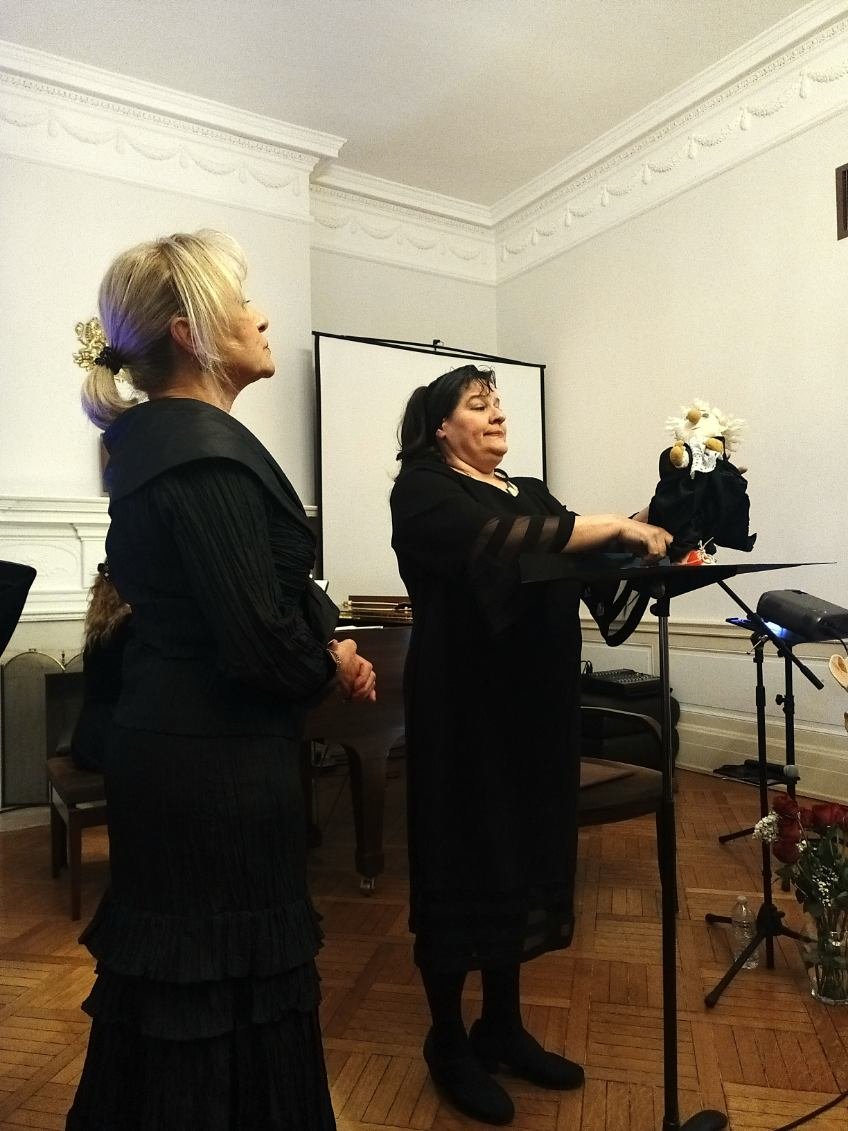


On March 21, 2025, the Bulgarian Music Society hosted a special spring concert at the Bulgarian Embassy in Washington, DC, entitled "Art is Peace." The concert captivated the audience with its depth and originality. Inspired performances by pianists Jeni Maneva and Ivo Kalchev created an immersive atmosphere, beautifully complemented by the artistic magic of Julia Tasheva, actress, puppeteer, and sand artist.
Actress Lilia Slavova enriched the experience with poetic recitations of works by Petrarca, Robert Burns, and Simona Assenova. The compelling interplay of music, poetry, and visual art established a profound dramaturgical connection among compositions by Bill Evans, Debussy, Prokofiev, Dobrinka Tabakova, and Schumann, reinforcing the universal notion that art stands as an antithesis to war and an enduring symbol of peace.
The concert emphasized art’s unique power to touch hearts, foster empathy, and open dialogues about a more peaceful world. The closing performances of Bill Evans’ "Peace Piece" and Jon Fosse's reading of "Art is Peace" left the audience deeply moved, with an emotional resonance that lingers long after the event has concluded.
"Art is Peace" reminded everyone present that the true purpose of art lies in transcending boundaries and creating a shared language of humanity.
March 22, 2025
Washington DC
Nelly Tsoneva/ Krassi Genov

A Musical Portrait of Bulgaria

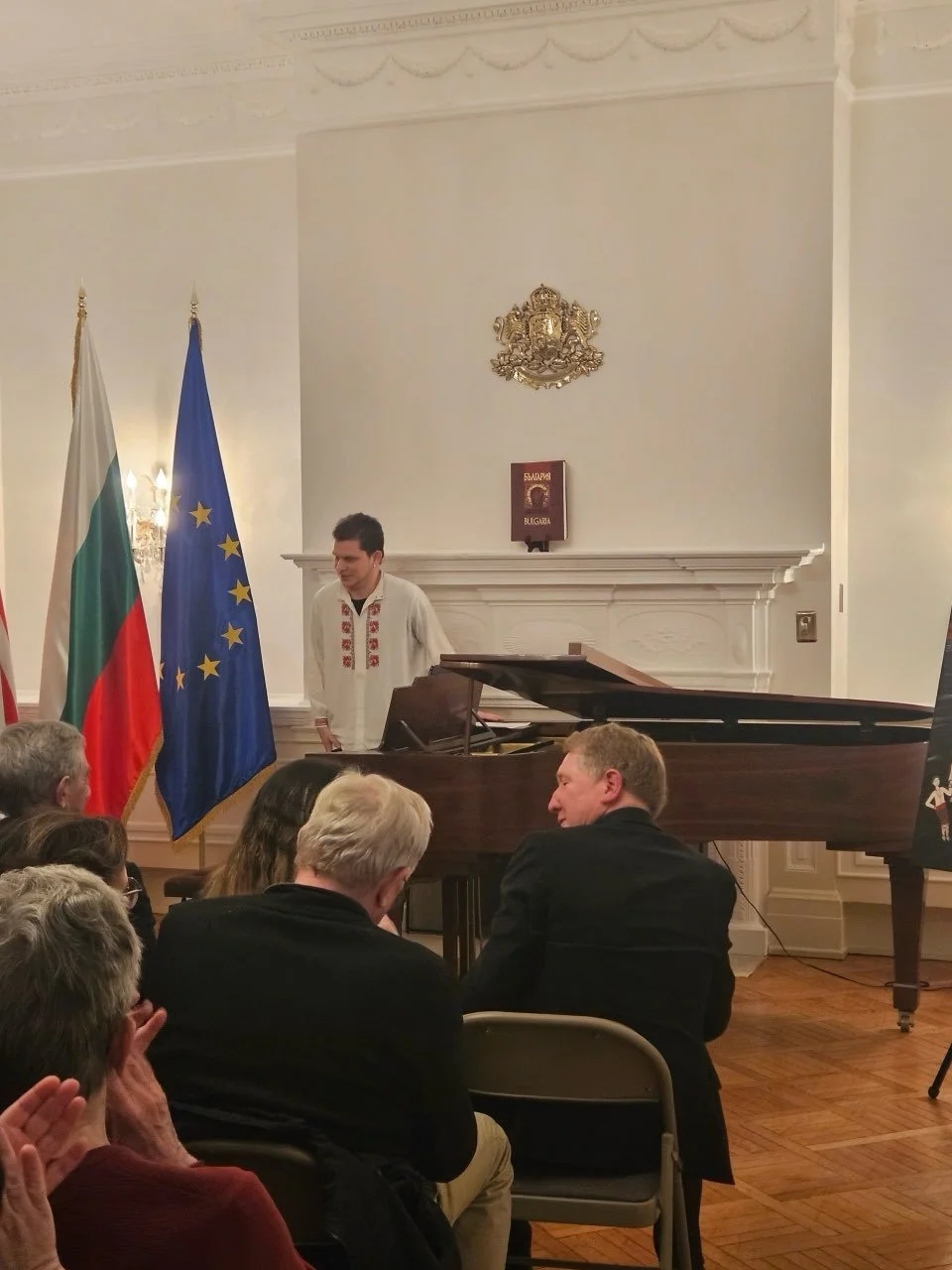
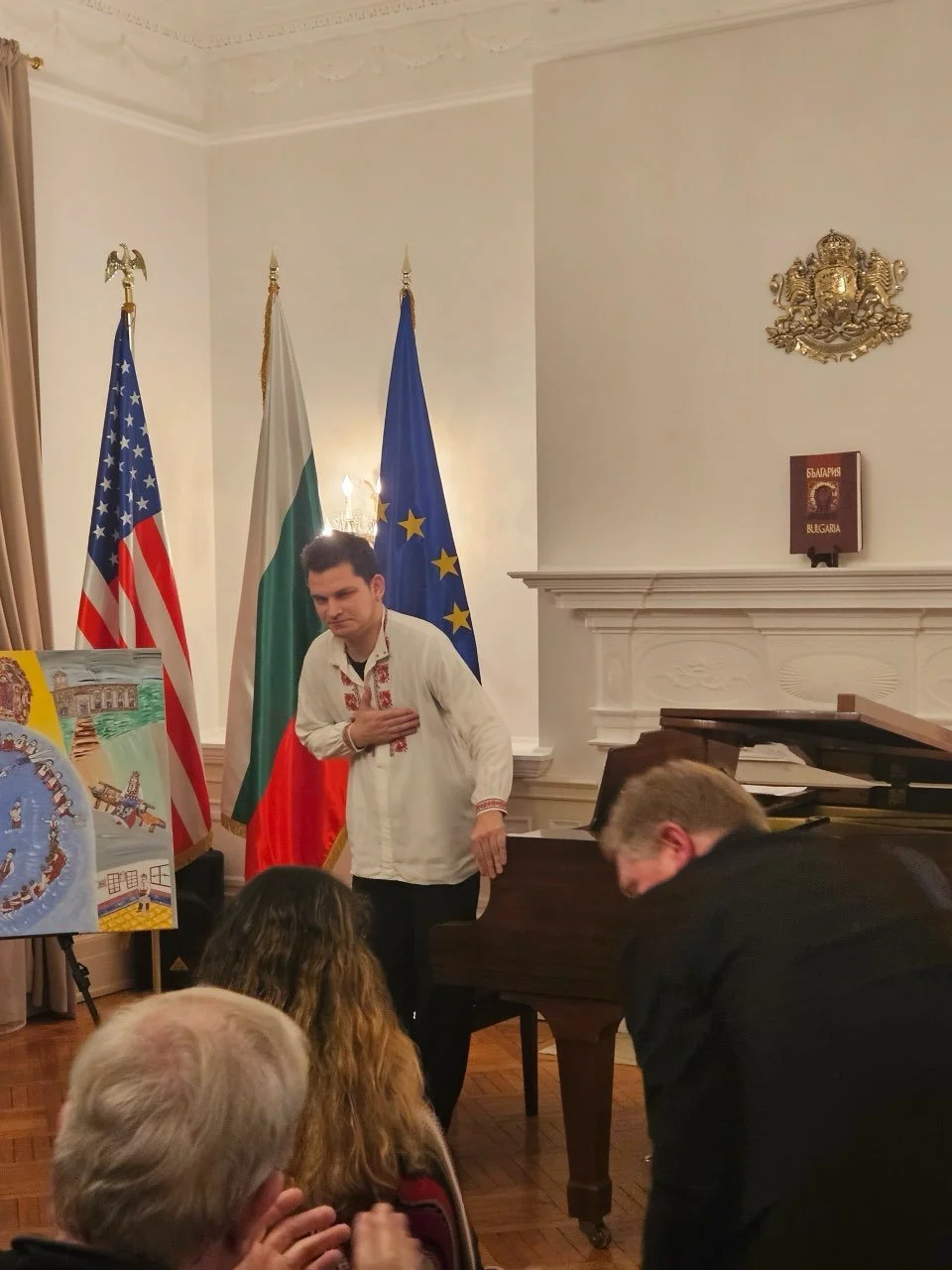
On January 31, 2025, the Bulgarian Musical Society held its first concert of the year at the Embassy of Bulgaria in Washington, D.C. Staying true to its tradition—offering something for every musical taste—the event once again captivated the audience with a diverse program, rich atmosphere, and deep emotions.
Once again, the grand piano resounded in its full power, illuminated by the virtuoso performance of Georgi Lekov. The young Bulgarian pianist, possessing remarkable technique and profound musical sensitivity, drew from the keys a rich palette of sounds—from ethereal delicacy to thunderous expressiveness. Every tone, every nuance intertwined into a musical enchantment that mesmerized the hearts of those present.
The program was diverse yet deeply connected—like a conversation between the past and present of Bulgarian music. It featured works by Pancho Vladigerov, Lyubomir Pipkov, Marin Goleminov, Svetoslav Obretenov, as well as pieces by a newer generation of composers—Alexander Vladigerov, Krasimir Kyurchiyski, Milcho Leviev, Krasimir Taskov, Tsvetan Dobrev, and Yordan Goshev.
The audience was spellbound—the gentle breath of the Bulgarian mountains and murmuring rivers came alive in "Ruchenitsa" by Pancho Vladigerov; "Nani Mi, Nani, Damyancho" by Lyubomir Pipkov transported everyone into a nostalgic reverie; "Dilyano, Dilbero" by Alexander Vladigerov shimmered in its exquisite variations, while "Polegnala e Todora" by Krasimir Kyurchiyski resonated like a deep, meditative prayer. The evening reached its grand culmination with "Triumph of the Bells" by Vasil Kazandzhiev, whose majestic chimes provided a ceremonial and powerful finale to this extraordinary musical night.
Georgi Lekov masterfully wove folk intonations and contemporary harmonies, crafting a pianistic image of Bulgaria—a country of rhythm, light, and deep musical memory.
Currently, Georgi Lekov is a doctoral student and assistant at the University of Connecticut, residing in New York City. Dedicated to contemporary piano art, he has participated in prestigious international premieres in the USA, Canada, Europe, and Turkey and has won numerous competition awards in Bulgaria, Romania, Cyprus, and Belgium.
This piano recital in Washington will remain long in the hearts of those present—not only as a display of technical mastery but as an emotional journey through some of the most brilliant pages of Bulgarian musical culture.
It is no coincidence that Ivo Kalchev, the artistic director of the Bulgarian Musical Society, emphasized that the exhibition by Dilyana Kirova—featuring paintings inspired by Asen's Fortress, the Nestinari fire dancers, the men's ritual dance in Kalofer on Epiphany, and the grace of Bulgarian rhythmic gymnasts—complemented the musical evening with a sense of warmth, sensitivity, and the magic of Bulgarian art.
This evening was not just a concert but a celebration of Bulgarian culture—a synthesis of music, tradition, and art. A memory that will linger long in the souls of those who were there and experienced the beauty of Bulgarian piano music.
January 31, 2025
Nelly Tsoneva
Washington DC

Bulgarian Music Society Turns 15!
With unwavering dedication and vision, the Bulgarian Musical Society continues to inspire audiences and celebrate the universal power of music for generations to come.
by Nelly Tsoneva/Krassi Genov
Artistic directors Ivo Kalchev and Jeni Maneva credit their success to teamwork. For them, music is not just a passion but a calling that guides the Bulgarian Music Society’s concert programs, repertoire selection, and collaborations with talented musicians.
From the Start
Fifteen years ago, as the vision was taking shape, Dr. Lazarov, a generous member of the Bulgarian diaspora, learned about our efforts to kickstart this project and suggested that concerts would take place at the Bulgarian Embassy, where people could come together and listen to music.
“However, the embassy lacked an instrument,” Kalchev recalls. “I offered to find a grand piano, and Dr. Lazarov generously agreed to help us cover the cost. I discovered a stunning seven-foot Kawai concert piano in Baltimore, and this piano became the cornerstone of our concerts since 2009.”
A Growing Community and Unique Identity
The early concerts quickly became a meeting point for the community, drawing large and enthusiastic crowds. “It wasn’t just about the music,” Kalchev says. “People wanted to meet other Bulgarians, socialize with the ambassador, and enjoy a glass of wine. Dr. Lazarov insisted that wine should always be part of the gatherings. Even after his passing, this tradition lives on as a tribute to his memory.”
Establishing a unique identity in Washington’s vibrant cultural scene was no small challenge. Yet the Bulgarian Music Society has thrived for 15 years, offering a tapestry of experiences with musicians, poets, artists, and groups from around the world. It delivers unique performances that resonate with the audience.
Jeni Maneva reflects on the Society's diverse audience: “What’s fascinating is that our audience is never the same. Each concert draws a mix of people, including many invited by the performers. We have a core group of Bulgarian attendees and a larger circle of supporters from all over DC!”
Kalchev adds: “Our audience is incredibly international, and our programs are just as diverse—classical works are essential, but we also feature many Bulgarian compositions. There’s a bit of everything: opera, operettas, Broadway hits, poetry, dance, and cross-genre collaborations. This variety ensures there’s something for everyone.”
Memorable Performances
Each concert feels personal and unique. The mix of genres—from classical and jazz to folk and Broadway—offers an enchanting musical experience. Kalchev recounts: “One of the highlights was when we combined classical music with folklore. Two bassoonists performed alongside a dancer interpreting Bulgarian folk traditions. This enchanting blend of classical music and folklore culminated in a lively Bulgarian horo dance, leaving the audience captivated. Such a fusion is rarely found elsewhere!”
Maneva reflects on another special moment: “We organized a concert at a modern church on Martin Luther King Boulevard. It looks like a library from the outside, but inside, it’s a stunning space. The program included an orchestra, a choir, and an organ performance. It was incredible—so many people came to watch!”
Over the years, the Bulgarian Music Society has organized more than 60 concerts featuring over 400 performers. Its repertoire includes iconic composers like Bach, Verdi, and Gershwin and Bulgarian greats like Pancho Vladigerov and Dobri Hristov. Performances often include unique elements, such as poetry recitals with piano accompaniment and digital sand art projected on-screen.
Kalchev notes: “These aren’t programs you’ll find in major concert halls. We marked the 100th anniversary of Boris Christoff with a concert by his student Genko Genchev and organized a remarkable performance by the legendary Theodosi Spassov. These original, unconventional programs set us apart.”
The Road Ahead
As the Society enters its 16th season, new plans and dreams are on the horizon. The aim is to continue offering a diverse array of programs that captivate audiences and foster a deep appreciation for music.
Kalchev concludes: “We strive to offer something for everyone’s taste. This blend of variety and inclusivity has been the key to our success. Our mix of genres—classical, folk, jazz, and more—is unique. We’re proud to create experiences that touch the hearts of our audience and bring them closer to the magic of music.”
The Bulgarian Music Society has become a cultural beacon, uniting people through music and building a prestigious reputation. Its success is a testament to the passion, creativity, and dedication of its artistic directors. Thanks to their unwavering dedication and vision, the Bulgarian Music Society will continue to inspire audiences and celebrate the universal power of music for generations to come.


The Songs of the Other
by Nelly Tsoneva/Krassi Genov
An unforgettable evening unfolded as the Bulgarian Music Society presented "The Songs of the Other," a concert celebrating the rich interplay of cultures and traditions. Featuring the captivating Duo Sildasan — mezzo-soprano Daniela Tosic and marimba virtuoso Sylvia Zakarian — the event was a testament to the universal power of music.
"This concert emphasizes our commitment to complete freedom of repertoire, intertwining cultures to explore the world of music," reflected Ivo Kalchev, the society’s artistic director.
The theme resonated deeply with the audience, as Ambassador Georgi Panayotov noted that the venue could barely accommodate the many admirers of polyphonic art.
Sylvia Zakarian, an Armenian born in Bulgaria, shared her perspective: "Our nations have long been connected through challenging historical moments. That is why our songs carry sadness, joy, longing, and a spirit of rebellion." She highlighted how Armenian songs have been preserved through the work of Komitas Vardapet, included in UNESCO’s Memory of the World Register, and through composers like Alan Hovhannes Chakmakjian, whose handwritten scores the duo discovered at the Armenian Cultural Foundation.
Daniela Tosic opined that we often ask the question, "Whose song is this?" as explored in Adela Peeva's film. Although a song is inseparable from the identity of a particular nation, it often transcends the borders of one Balkan country or another, as our joys and sorrows are so alike. "We share not only physical resemblances but also a similar soulfulness."
The program featured Neapolitan songs by Pasquale Tassone and Nikola Radan’s evocative "Byzantine Blue," capturing the despair and hope of those fleeing Constantinople in 1493.
In the presence of composer George Tantchev, Sylvia Zakarian performed a solo marimba concert piece — a virtuosic work inspired by folk music from the Shopluk region in Western Bulgaria. With its rich timbres, intricate ornamentation, and demanding technical challenges, this elegant composition was warmly received by the audience.
Cheerful selections like Georgi Tanchev’s "Ergen Dyado" and "Reche Mama" brought a lighthearted close to the evening, delighting listeners with humor and charm. These folk-inspired works, popularized by The Mystery of Bulgarian Voices, reminded everyone of the vibrant soulfulness of Balkan music.
November 22, 2024
Washington DC